
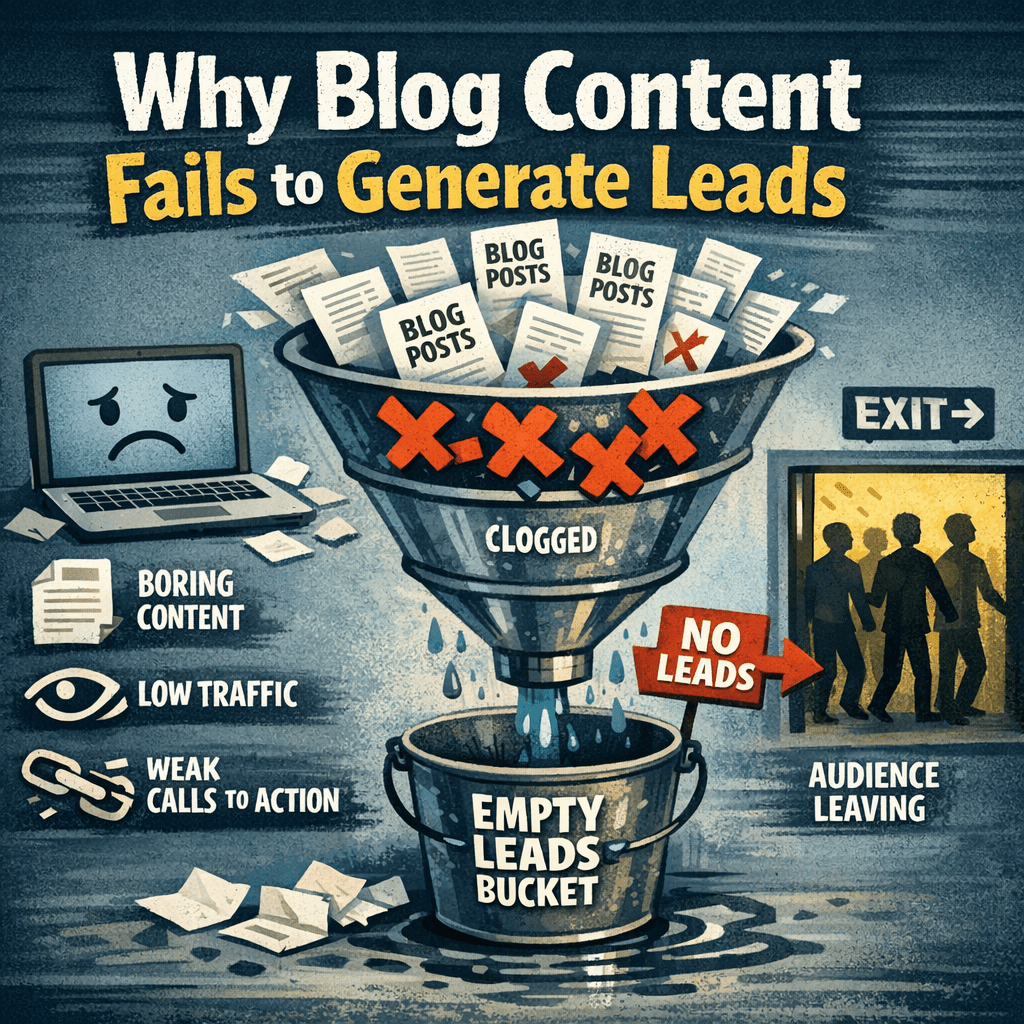
Most blog posts fail for one simple reason: they were written to attract clicks, not leads. In 2026, that gap matters more than ever. AI can summarize average content in seconds, competition is everywhere, and service business owners do not have time to publish “good enough” articles that never produce calls, forms, or booked jobs. If your blog traffic looks fine but your pipeline stays quiet, the problem is usually not volume. It is strategy. The good news is that blog content not converting is fixable. With the right structure, offer, and follow-up system, your blog can become a real lead source instead of a content treadmill.
Contents
- 1 Why Blog Content Fails to Generate Leads
- 2 Fixing Blog Content Not Converting in 2026
- 3 The 2026 AI Era and Why Blogs Fail Now
- 4 Common Content Strategy Mistakes That Kill Leads
- 5 Real-World Application for Local Service Businesses
- 6 Pro Tips to Improve Blog Conversions
- 7 Tools and Tech Stack That Help
- 8 Want This Done for You?
- 9 FAQs
- 9.1 Why do most blog posts fail to generate leads?
- 9.2 How long does it take for blog content to generate leads?
- 9.3 Is blog content still worth it in 2026?
- 9.4 What is the biggest reason blogs are not converting?
- 9.5 How can I improve blog conversions fast?
- 9.6 Should small businesses still invest in content marketing?
- 9.7 What tools should I use for blog lead generation?
Why Blog Content Fails to Generate Leads
Most blog content fails because it is built around keywords, not buyer intent. That is one of the biggest content marketing mistakes service businesses make. A post may rank, get a few visits, and even earn social shares, but if it does not speak to a problem someone is trying to solve right now, it will not generate leads. In other words, traffic without intent is noise.
Another reason blogs fail is that they stop at education. They explain a topic, but they do not guide the reader to a next step. A person reading “How Local Businesses Can Use Google Ads Profitably” may be interested, but if the post never connects that insight to a service, audit, checklist, or contact path, the opportunity is lost. This is why blog content not converting is usually a message problem, not just a writing problem.
The third issue is weak alignment between the blog and the rest of the funnel. Many businesses publish content that has no connection to their homepage, service pages, email sequence, or sales process. The result is a disconnected experience. Readers learn something, then leave. If the content does not support your offer, your authority, and your conversion path, it becomes an expense instead of an asset.
Why blogs fail in the first place
A lot of blogs are written for broad visibility, not revenue. They answer generic questions, target vague terms, and avoid direct offers because the writer does not want to “sound salesy.” But service businesses do not need more polite content. They need content that connects problems to solutions quickly.
That means the post has to do more than educate. It has to qualify the reader, build trust, and move them toward action. A good blog should make the right person think, “This is exactly what we need,” not just “That was interesting.”
The real problem behind content not generating leads
When content does not generate leads, the real issue is usually one of three things: wrong audience, wrong angle, or wrong CTA. The article may be useful, but not useful to a buyer. It may be optimized, but not persuasive. Or it may have a CTA, but the CTA is weak, hidden, or disconnected from the topic.
For example, a blog about “SEO blog mistakes” should naturally lead to an SEO audit, content rewrite, or done-for-you service. If it ends with “thanks for reading,” it is not built to convert. The content did its job as information, but failed as marketing.
Why SEO alone is not enough
SEO can bring attention, but attention is not the same as demand. In 2026, search engines and AI tools reward clear, useful answers, which means many average blogs will still get some visibility. But visibility without a conversion strategy is a dead end.
A high-ranking blog post should be treated like a sales page in disguise. It must answer the search query, show expertise, and give the reader a reason to take the next step. If it only chases traffic, it will often become one of the most expensive assets on the site: busy, but not profitable.
Fixing Blog Content Not Converting in 2026
The fix starts with intent. Before writing, ask: what is this reader trying to solve, and what action should they take next? If you are writing about “Website Design That Converts in 2026,” the reader probably wants more leads, better trust, and fewer lost opportunities. Your content should lead them toward a service that solves those outcomes.
Next, your blog needs a clear structure. Use a strong opening, direct answers, practical examples, and a visible next step. The best converting blogs are easy to skim and easy to trust. They do not bury the point. They get to it fast, then back it up with specifics.
Finally, treat content as part of a system. Blog traffic should feed email marketing, retargeting, service pages, and lead magnets. That is how content becomes revenue. In 2026, the businesses winning with content are not just publishing more. They are building a path from reader to lead.
Start with buyer intent, not just keywords
One of the biggest seo blog mistakes is choosing topics only because they have search volume. A keyword can look good on paper and still attract the wrong audience. If the searcher is a student, a hobbyist, or a DIY browser, your post may get traffic but no leads.
Instead, target keywords that reveal commercial intent. Search terms like “best email marketing automation for service businesses” or “how local businesses can use Google Ads profitably” show that the reader is looking for a solution, not just information. That is where conversion starts.
Build the post around one next step
Every blog post should have one clear job. Do you want the reader to request an audit, download a checklist, view a service page, or join your email list? Pick one primary action and build the article around it.
If you give readers too many choices, conversion drops. But if you give them one clear, low-friction next step, you increase the odds that they will act. For service businesses, that next step should feel simple, helpful, and immediate.
Use proof, not just promises
Readers do not trust vague claims anymore. They want to know what worked, for whom, and why. Add examples, outcomes, and practical explanations wherever possible.
For instance, instead of saying “good content builds trust,” explain how a blog post can reduce sales friction by answering pricing questions, clarifying service scope, or showing a process. That kind of detail makes the article feel useful and credible. It also makes your offer feel safer.
The 2026 AI Era and Why Blogs Fail Now

AI has raised the bar. Readers can now get quick summaries from search results, chat tools, and AI assistants without clicking through to weak content. That means average blog posts lose attention faster than before. If your article does not offer depth, specificity, or a clear business angle, it gets replaced by an AI overview or skipped entirely.
At the same time, AI makes speed a competitive advantage. Businesses can publish more content, faster, with better research support. That does not mean human strategy is obsolete. It means generic writing is dead. The winners will use AI for efficiency, then layer in real expertise, local relevance, and a conversion path.
This is also why personalization matters more now. A blog for plumbers should not sound like a blog for SaaS startups. A post for dentists should not read like one for real estate agents. AI can help draft the content, but only a smart marketer can shape it for the audience, the offer, and the sale.
Why AI makes weak blogs fail faster
AI does not create the problem, but it exposes it. If your post is thin, repetitive, or overly broad, users can spot that quickly. Search engines can too. That means the old strategy of publishing lots of average content and hoping something ranks is becoming less effective.
Now, your content has to earn attention. It should be useful, specific, and connected to a real business outcome. If not, readers move on, and search systems have less reason to feature it.
How automation changes the funnel
The good news is that automation can improve conversion if it is used correctly. Blog readers can be routed into an email sequence, tagged by topic, and followed up with targeted content. That turns a single post into a longer lead-nurture system.
For example, someone reading about “content strategy mistakes” can be offered a content audit or a simple checklist. Then email automation can follow up with related posts, case studies, and service pages. That is how blogs become part of a revenue engine instead of a one-time visit.
Why speed now matters for service businesses
Service businesses do not always have the luxury of waiting six months for content to work. They need leads now. That is why content has to be paired with faster channels like paid ads, email, and conversion-focused pages.
A strong blog can support those channels by building trust and improving close rates. But it should not sit alone and hope for results. In 2026, speed, clarity, and follow-up matter just as much as rankings.
Common Content Strategy Mistakes That Kill Leads
The first mistake is writing to “cover the topic” instead of solve the problem. A lot of blogs explain what something is, but do not explain what to do next. That creates an information gap, not a conversion path.
The second mistake is weak internal linking. If a blog post does not point readers to relevant service pages, case studies, or lead magnets, it creates dead traffic. This is one of the most overlooked seo blog mistakes because the content may still perform in search but fail in the funnel.
The third mistake is using a CTA that is too generic. “Contact us” is not a strategy. Readers respond better to specific, low-pressure offers like a free audit, a simple plan, or a short email summary. That is especially true for service businesses that want trust first and sales second.
- Publishing broad, low-intent topics that do not attract buyers
- Writing long posts with no clear next step
- Hiding or repeating the same weak CTA
- Ignoring internal links to services and contact pages
- Failing to match content to the reader’s stage in the buying journey
- Using AI content without human editing, proof, or business context
- Chasing traffic metrics instead of leads and calls
Real-World Application for Local Service Businesses
For plumbers, a blog about seasonal plumbing issues should do more than explain the problem. It should connect the issue to emergency service, maintenance plans, or a quick quote request. That way, the article supports lead generation instead of just educating homeowners.
For dentists, content about cosmetic treatments or local dental care should reassure, simplify, and guide. Readers often have fear, price concerns, or confusion. A blog that addresses those concerns directly can improve conversions from both organic traffic and paid campaigns.
For real estate agents and coaches, trust is the main currency. Blog content should show process, proof, and personality without sounding generic. The goal is not to “go viral.” The goal is to make the right person feel confident enough to reach out.
Example: email marketing automation for service businesses
A service business blog about email automation should not just define automation. It should show how follow-up sequences recover missed leads, nurture cold prospects, and book more calls. Then it should invite the reader to get a tailored plan.
That kind of content works because it ties the topic to revenue. It speaks to the pain point, shows the fix, and points to the next action. That is what converts.
Example: local SEO and Google Ads content
A blog about local Google Ads should explain what makes ads profitable, what mistakes waste budget, and how landing pages affect ROI. If the reader is a local business owner, they want fewer wasted clicks and more calls.
A useful post will show how to improve blog conversions by pairing the article with a clear landing page, a local offer, and a simple contact path. That makes the content much more valuable than a basic how-to article.
Pro Tips to Improve Blog Conversions
The best-performing blogs often include a short conversion summary near the top. This is a quick section that explains what the reader will learn and what they should do if they want help. It reduces friction and improves clarity.
Another advanced move is to align every blog topic with one service page. If the post is about content marketing mistakes, link it to a content service page or SEO service page. If it is about website design, connect it to your web design offer. That creates topical relevance and helps move readers deeper into the site.
Also, use AI to speed up research and outlines, but never let it write your final strategy alone. AI can help you produce faster, but human judgment is what makes content convert. The best agencies use AI to scale output, then edit for voice, proof, and business intent.
What most agencies do not tell you
Most agencies focus on impressions, rankings, and publishing volume because those are easy to report. But business owners care about leads, calls, and revenue. If a blog does not support those outcomes, it is not doing its job.
That is why content should be measured by assisted conversions, email signups, contact form starts, and lead quality. Traffic matters, but only if it moves someone closer to buying.
Tools and Tech Stack That Help
SEO tools like Ahrefs, SEMrush, and Google Search Console help you find intent-driven topics and identify content gaps. They are useful for spotting seo blog mistakes before you waste time on the wrong keyword.
Email tools like ConvertKit, Mailchimp, and ActiveCampaign help turn blog readers into leads through automated follow-up. If someone is not ready to buy today, email keeps the conversation going.
For paid traffic, Google Ads and Meta Ads can amplify your best content and bring faster data. And tools like Zapier, HubSpot, and other automation platforms can connect forms, email sequences, and lead tracking so nothing falls through the cracks.
Want This Done for You?
If you want blog content that does more than fill space, the fix is simple: build every post around intent, proof, and a clear next step. That is how you improve blog conversions without turning your site into a sales pitch.
Want this done for you? We’ll send you a plan — no meetings needed. We can review your current blog, identify why it is not generating leads, and map out the fastest way to turn it into a lead source.
FAQs

Why do most blog posts fail to generate leads?
Most blog posts fail because they attract readers but do not guide them toward an action. They educate without converting, so traffic stops at the article.
How long does it take for blog content to generate leads?
It depends on traffic, intent, and distribution. Some posts can generate leads quickly if they target high-intent topics and have a strong CTA, while SEO-driven posts may take weeks or months.
Is blog content still worth it in 2026?
Yes, but only if it is strategic. Blog content still matters for SEO, trust, and nurturing, but generic content is much less effective than it used to be.
What is the biggest reason blogs are not converting?
The biggest reason is poor alignment between the topic, the reader’s intent, and the offer. If those three do not match, conversions drop.
How can I improve blog conversions fast?
Add clearer CTAs, link to relevant service pages, target higher-intent keywords, and make the article more specific to your audience’s pain points.
Should small businesses still invest in content marketing?
Yes, especially if they need long-term visibility and trust. Small businesses just need content that is built around leads, not just pageviews.
What tools should I use for blog lead generation?
Use SEO tools for topic research, email automation tools for follow-up, and analytics tools to track form fills, clicks, and assisted conversion.
Blog content fails when it is written for traffic without a conversion plan. In 2026, that is no longer enough. Businesses need content that answers real questions, matches buyer intent, supports the sales funnel, and gives readers a clear next step. If your blog is not generating leads, the issue is usually strategy, not effort. Fix the intent, improve the structure, connect the content to your offer, and your blog can become a real lead source instead of a dead asset.

We would love to hear from you!
Contact us about your digital marketing needs and let's team up to grow multi-folds together!