
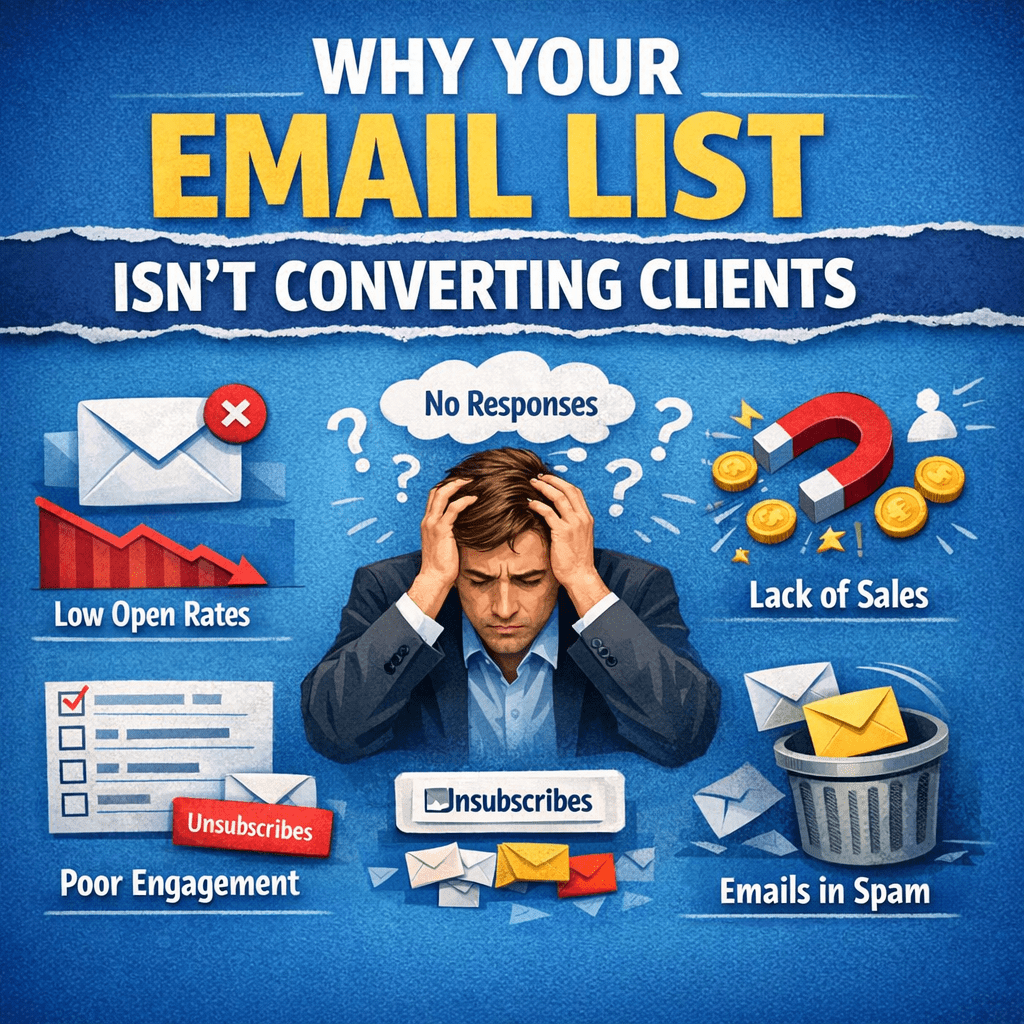
You may be collecting emails, but if your list is not turning into sales, the problem is usually not the list itself. The real issue is often a weak email marketing strategy, poor timing, unclear offers, or messages that never move people to action. In 2026, service businesses can’t afford to treat email like a digital storage box for contacts. With AI making content faster, competition sharper, and buyers more selective, your emails have to do more than “stay in touch.” They need to build trust, create interest, and bring people back when they’re ready to buy. If your email list isn’t converting clients, the good news is that the fix is usually practical, fast, and measurable.===
Contents
- 1 Why Your Email List Isn’t Converting Clients
- 2 Quick Answer: Why Emails Are Not Converting
- 3 Why This Matters in 2026
- 4 The Main Reasons Your Email List Isn’t Converting
- 5 Fix the Gaps Before Your Next Email Campaign Goes Out
- 6 Real-World Application for Local Businesses
- 7 Common Mistakes to Avoid
- 8 Pro Tips for Better Email Marketing for Leads
- 9 Tools & Tech Stack That Make This Easier
- 10 Exploring Opportunities
- 11 Want This Done for You?
- 12 FAQs
- 12.1 How long does it take to fix an email list that is not converting?
- 12.2 Is email marketing still worth it for small businesses?
- 12.3 What is the biggest reason emails do not convert?
- 12.4 How many emails should be in a nurture sequence?
- 12.5 What tools should I use for email marketing?
- 12.6 Should I focus on open rates or conversions?
- 12.7 Can AI help improve email conversions?
- 13 Conclusion
Why Your Email List Isn’t Converting Clients
If your email list is not converting, it usually means people signed up with interest but never got a clear reason to take the next step. That happens when the message is too generic, the offer is too vague, or the emails are sent without a strategy. In other words, the list is there, but the path to becoming a client is missing.
For service businesses, this is a common problem. A dentist, plumber, coach, or real estate agent may have dozens or hundreds of subscribers, yet still get little or no business from email. The issue is rarely volume. It is usually the disconnect between what people expected when they signed up and what they receive afterward. If your emails feel like noise, people ignore them.
The fix starts with clarity. Every email should have a purpose, a promise, and a next step. When your email marketing strategy is built around one audience, one problem, and one action, conversions improve fast. That is why email marketing for leads works best when it is simple, relevant, and tied to real business outcomes.
Quick Answer: Why Emails Are Not Converting
Most email lists fail to convert because they are built without a clear follow-up system. People join, but they are not segmented, nurtured, or guided toward a specific offer. If the emails are generic, inconsistent, or focused only on selling, subscribers lose interest.
To improve email conversions, send messages that match the subscriber’s intent, solve one real problem at a time, and make the next step obvious. A strong email marketing strategy should build trust first, then move readers toward a call, quote, booking, or purchase.
Why This Matters in 2026

AI has changed how people consume content, compare businesses, and decide who to trust. Inbox competition is heavier than ever, and buyers can spot low-value emails instantly. If your emails sound automated in the wrong way, people tune out.
At the same time, AI gives businesses a major advantage when used correctly. You can personalize faster, test subject lines quicker, automate follow-ups, and segment your audience with more precision. That means small businesses can compete with bigger brands, but only if their email marketing strategy is built for speed, relevance, and conversion.
For local businesses, this matters even more. People searching for plumbers, dentists, HVAC companies, or coaches are often comparing options quickly. Email gives you a second chance to stay in front of them without paying for every click. But that only works if the emails are relevant enough to bring them back.
The Main Reasons Your Email List Isn’t Converting
1. You’re collecting leads, but not qualifying them
A lot of lists grow because of a discount, free guide, or generic lead magnet. That may increase signups, but not all subscribers are ready buyers. If your opt-in offer attracts the wrong people, your conversion rate will stay low.
A better approach is to align the lead magnet with the service. For example, a roofing company should not offer a broad “homeowner checklist” if the goal is urgent repair leads. Instead, offer something tied to a real pain point, like “How to Spot Roof Damage Before It Gets Expensive.” That attracts more serious prospects.
2. Your emails do not build trust fast enough
People rarely buy from the first email. They buy after they believe you understand their problem and can solve it. If your sequence jumps straight into selling, it feels premature.
Use the first few emails to prove expertise. Share a common mistake, a quick win, a short story, or a case study. This is where email engagement tips matter most: make the message useful before you make it promotional. Trust is what turns a subscriber into a client.
3. Your offer is unclear or too broad
A weak offer kills conversions. If subscribers do not know exactly what you do, who it is for, and why they should act now, they will delay or ignore the email. This is one of the most expensive email marketing mistakes because it makes every campaign less effective.
The fix is to keep the offer simple. Don’t ask people to “learn more” when what you really want is a booking, quote request, or consultation. State the outcome clearly. For example: “Want more local leads? We’ll review your current setup and send you a simple plan.” That is direct, low-pressure, and easy to say yes to.
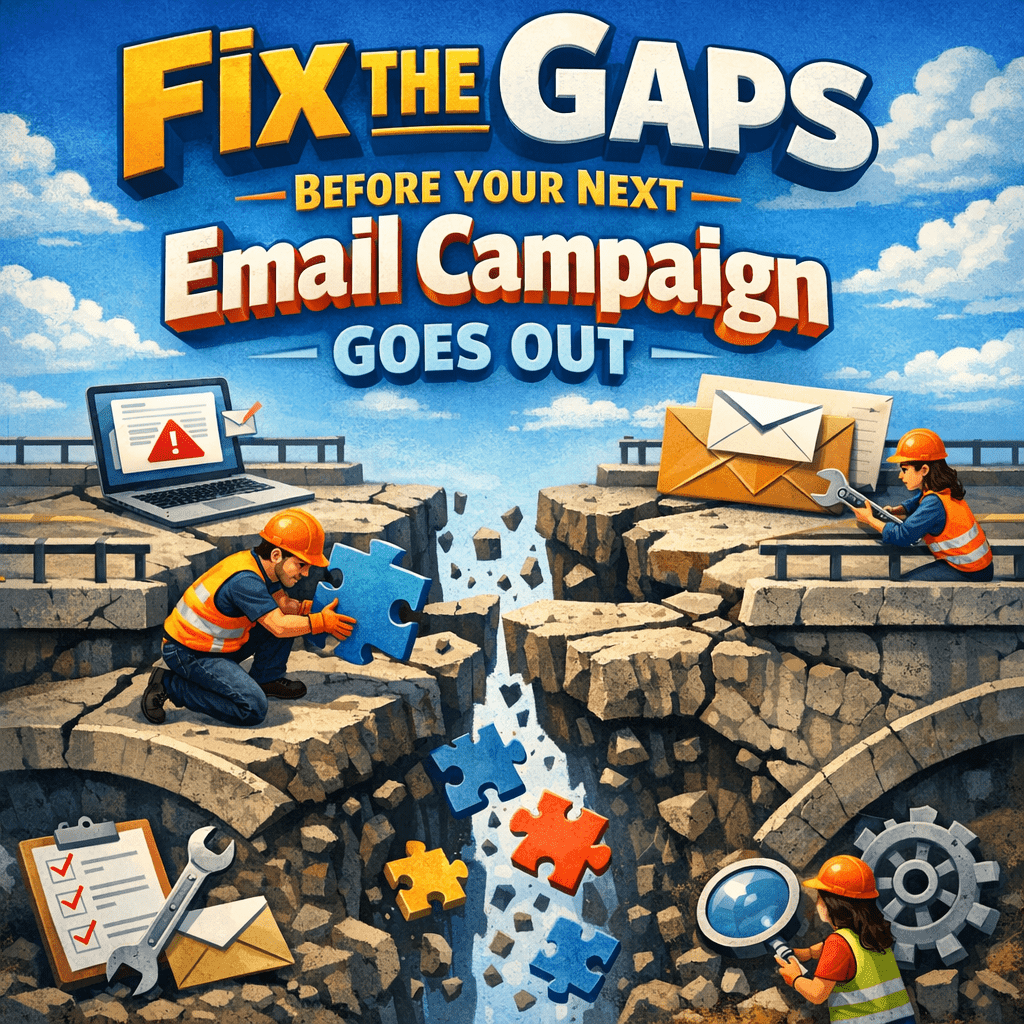
Fix the Gaps Before Your Next Email Campaign Goes Out
Step 1: Audit your subscriber journey
Start by mapping what happens from signup to sale. What did the person opt in for? What email do they get first? What happens after that? If there is no clear sequence, the list is not being managed as a sales channel.
A simple journey should include a welcome email, a trust-building sequence, a problem-awareness email, a proof email, and a conversion email. Each step should move the subscriber closer to action. Without that structure, even a good list goes cold.
Step 2: Segment by intent, not just by name
Not every subscriber wants the same thing. Some are ready to buy now. Some are researching. Some just want tips. If you send the same email to all of them, relevance drops.
Use tags or segments based on behavior, location, service interest, or lead source. A real estate agent may separate first-time buyers from sellers. A dentist may separate cosmetic inquiries from emergency leads. A coach may separate business owners from personal development clients. Better segmentation leads to better email conversions.
Step 3: Write for one action per email
One email, one goal. That rule alone can improve performance. Too many emails try to educate, persuade, sell, and entertain all at once. That confuses readers.
Make the main action easy to find. If you want a reply, say so. If you want a booking, include the booking link once and explain why it matters. If you want someone to read a case study, keep the focus there. Clear writing improves conversions because it reduces friction.
Step 4: Use proof, not hype
Service businesses win with proof. Before-and-after results, screenshots, short testimonials, case studies, and local examples build trust faster than broad claims. People want to see that you can help businesses like theirs.
For example, instead of saying “We improve results,” say “We helped a local HVAC company turn a weak list into booked service calls using a 5-email follow-up sequence.” That is specific, believable, and useful.
Real-World Application for Local Businesses
For plumbers, the problem is often urgency. People do not care about a long email series when the issue is immediate. The fix is to use email for trust and follow-up, not just promotions. A short sequence after a quote request can remind the homeowner what to expect, share common warning signs, and make it easy to book.
For dentists and med spas, email works well for education and repeat visits. Patients may not book right away, but they do respond to reminders, seasonal offers, and value-based tips. A clear email marketing strategy can increase reactivations, referrals, and appointments without feeling pushy.
For real estate agents and coaches, email is often the bridge between interest and action. People may follow you on social media, visit your website, or download a guide, but email is where trust compounds. If your emails solve problems, answer objections, and point to a next step, they can produce leads long after the original signup.
Common Mistakes to Avoid
- Sending the same newsletter to everyone on the list
- Writing emails that are too long and unfocused
- Promoting before building trust
- Using weak subject lines that never get opened
- Not having a clear CTA in every email
- Ignoring mobile formatting
- Failing to follow up after a reply or click
- Letting leads sit without a nurture sequence
- Collecting emails without a sales goal
- Assuming more subscribers means more clients
These email marketing mistakes cost time and money because they make the list look active while quietly reducing conversions. Fixing them usually improves results faster than adding more subscribers.
Pro Tips for Better Email Marketing for Leads
One advanced strategy most agencies skip is behavior-based follow-up. If someone clicks a link about pricing, they should not get the same follow-up as someone who opened but did not click. That small shift can dramatically improve email conversions.
AI can help here, but only if you use it for structure, not spam. Use AI to draft variations, summarize customer pain points, and create segment-specific message ideas. Then edit the copy so it sounds human, clear, and tied to one business goal. Automation should make the email more relevant, not more robotic.
Also, test the order of your emails. Many businesses send too much educational content before making an offer. In some cases, a shorter sequence with a faster conversion step performs better. The best email marketing strategy is not the most complicated one. It is the one that gets the next action.
Tools & Tech Stack That Make This Easier
For email marketing, tools like ActiveCampaign, Mailchimp, ConvertKit, and HubSpot can help with automation and segmentation. If you want stronger deliverability and lifecycle tracking, choose a platform that supports tagging and behavior triggers.
For SEO and content support, tools like Semrush, Ahrefs, Google Search Console, and Google Analytics can show which pages and topics attract the right leads. For paid traffic, Google Ads and Meta Ads can feed your list with qualified prospects when paired with a strong opt-in offer.
For automation, Zapier and Make can connect forms, CRM updates, and follow-up workflows. That means fewer manual tasks and faster response times. If your team is small, this saves hours every week.
Exploring Opportunities
If you want to improve results beyond email, this topic connects naturally to other services. A stronger website design can increase opt-ins and bookings. SEO can drive more qualified traffic to the lead magnet or landing page. Paid ads can fill the list faster with the right audience.
Want This Done for You?
If your email list is not converting, you probably do not need more random newsletters. You need a cleaner strategy, a stronger offer, and a follow-up system that turns attention into action.
Want this done for you? We can review your current setup and send back a simple plan — no meetings needed. If you want more leads, more calls, and fewer missed opportunities, that is the fastest place to start.
FAQs
How long does it take to fix an email list that is not converting?
You can often see improvements within 2 to 4 weeks if you fix the offer, segmentation, and follow-up sequence. Bigger gains usually come after testing and refinement.
Is email marketing still worth it for small businesses?
Yes. Email remains one of the highest-ROI channels because you own the audience and can follow up without paying for every click. It works especially well for service businesses with longer buying cycles.
What is the biggest reason emails do not convert?
The biggest reason is lack of clarity. If the email does not clearly solve a problem or point to a next step, readers will not act.
How many emails should be in a nurture sequence?
A simple sequence usually starts with 5 to 7 emails. That is enough to build trust, answer objections, and present an offer without overwhelming the subscriber.
What tools should I use for email marketing?
Use a platform with automation and segmentation, such as ActiveCampaign, ConvertKit, Mailchimp, or HubSpot. Pair it with analytics tools so you can track clicks, replies, and conversions.
Should I focus on open rates or conversions?
Conversions matter more. Open rates are useful, but they do not pay the bills. Track replies, bookings, quote requests, and sales first.
Can AI help improve email conversions?
Yes, if used correctly. AI can speed up drafting, segmentation ideas, and testing. But the message still needs a human touch, strong positioning, and a clear offer.
Conclusion
If your email list is not converting clients, the issue is usually not the list itself. It is the strategy behind it. Weak segmentation, unclear offers, poor follow-up, and generic messaging all reduce results.
The good news is that email is still one of the best tools for service businesses. When you fix the gaps, your list can become a reliable source of leads, bookings, and repeat business. Keep it simple, make it relevant, and guide readers toward one clear action. That is how email starts working like a real sales channel again.
We would love to hear from you!
Contact us about your digital marketing needs and let's team up to grow multi-folds together!